
Everyone has a few things they do or places they go only when you have someone visiting, right?
Like the tourist attractions, specific restaurants, etc. For me, it is the Falls. But back when I lived in Brazil, it used to be Olinda.
So, even when I came back to visit, I think I have only been there once when my brother-in-law was visiting for the first time from Norway.
But because Damianne is visiting, I took her to some of these places I haven’t been in ages, and it was a lot of fun.
Saturday
We started yesterday going to Recife Antigo, which is the historical centre of the city (Recife). Recife Antigo is an island near the old port, and once the port moved to Suape, it was renovated and became a place where people can find cafes, restaurants, ice cream shops, and a really nice street fair. Its cobblestone streets are so charming. It blends colourful colonial architecture and the local cultural scene.


We walked through the Rua do Bom Jesus (picture borrowed from the internet because I forgot to take one yesterday), one of the most famous and cute streets in Recife. It was elected the third most beautiful street in the world, and it is home to the Kahal Zur Israel Synagogue, the first synagogue established in the Americas (built during the Dutch occupation in the 1630s).

We visited the Paco do Frevo which is a museum and cultural centre located in a historical building that celebrates the history and living practice of Frevo and the local Carnival, one of the biggest Carnival celebrations in the world.

We checked out the Malakoff Tower, built between 1835 and 1855, which served as an observatory and today is also a cultural centre dedicated to science, photography, and music exhibitions.

Another fun thing to show and talk about, because we are very proud of our culture, was the Galo da Madrugada (“Rooster of the Dawn”). It is one of the biggest highlights of Pernambuco’s Carnival and holds the Guinness World Record as the largest Carnival parade in the world, regularly drawing over two million revellers to the streets of Recife.

The symbol of the event is a massive, multi-meter-tall giant rooster sculpture erected every year on the Duarte Coelho Bridge in downtown Recife, dressed in vibrant, colourful artistic themes. This one is just one of the many small roosters you can find around Recife Antigo.
Fun fact: unlike Rio’s stadium-style Sambadrome, Galo da Madrugada is a massive, open street party. Dozens of trios elétricos (sound trucks??) wind through a 6-kilometre route through the central streets of Recife, playing fast-paced Frevo rhythms while the massive crowd dances along below.
It serves as a living celebration of Frevo, uniting people from all walks of life, tourists, and locals in a giant sea of vibrant costumes, umbrellas, and non-stop energy.
Here’s an image of the Galo during the Carnival

We also saw a Maracatu group rehearsing, which was really nice. I love the sound of Maracatu, and it’s always amazing to see a group performing live. This is an Afro-Brazilian performance tradition combining heavy percussion drumming, costumed dance, and theatrical processions, and it dates back to the colonial era, originating from the coronation ceremonies of the “Kings of Congo,” organized by enslaved Africans in Brazil. In the video they are just playing the drums, but if you go to the YouTube video linked above, you can see the full performance.
Sunday
Today was Father’s Day here in Brazil, so we went out for lunch in a restaurant that serves local traditional food (Bode do No) because that’s all I want to eat when I’m here, and of course I’m showing the local cuisine to Damianne as well.

After that we headed to Alto da Sé, in Olinda’s historic centre. The Igreja da Sé (Cathedral of St. Anthony of Olinda) is located at the highest point of Olinda (Alto da Sé), and it’s one of the oldest churches in Pernambuco. There’s a small fee to enter (if there’s not a mass going on)—R$11.00—and you have access to the church, the museum, and the tombs. The cathedral was founded in 1537, initially as a small chapel before becoming a major cathedral.

Oh, by the way, it’s winter here, and there was not a single cloud in the sky, and it was over 30°C. 🥵
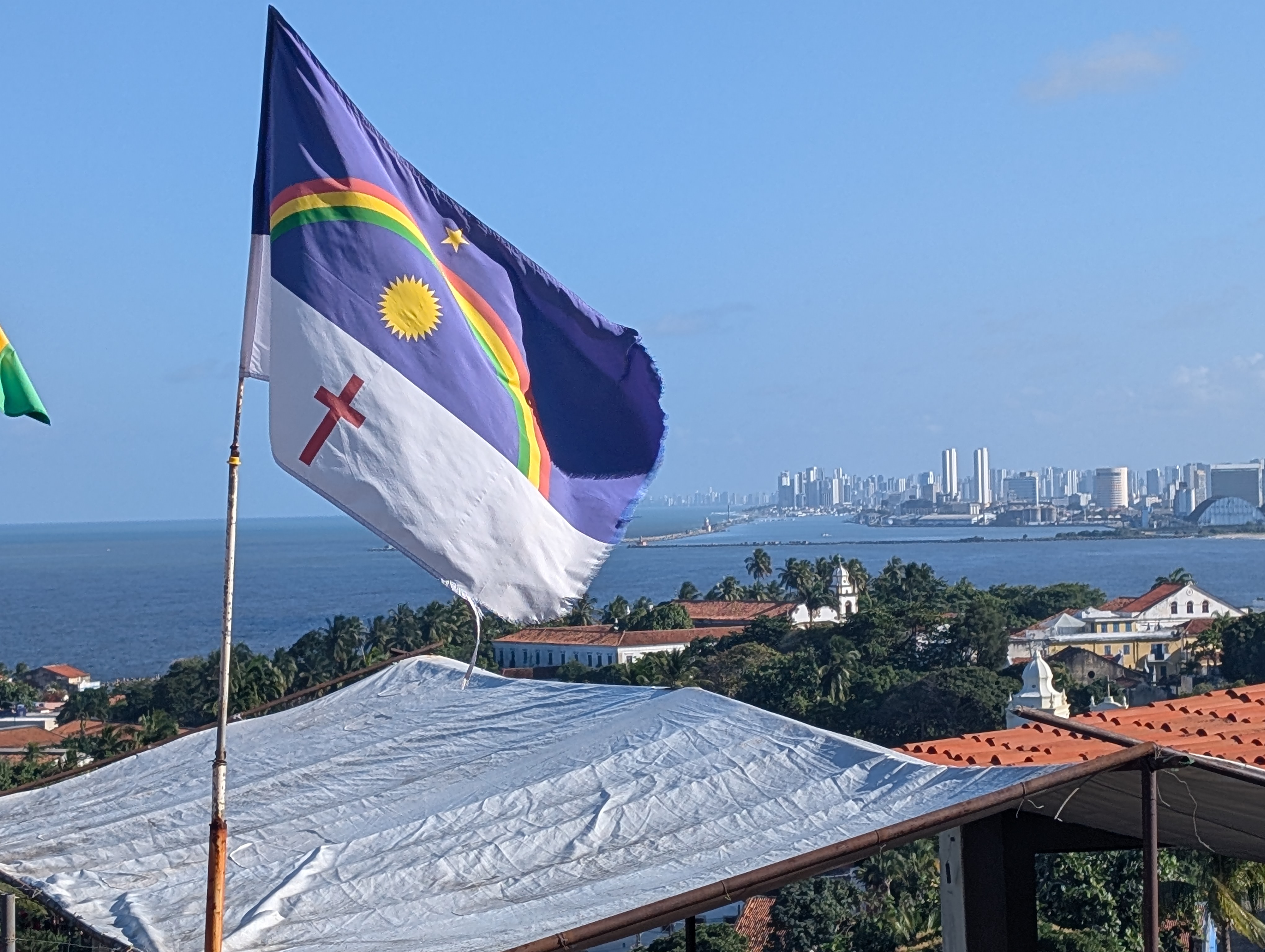
After that, we strolled through the crafts and food market outside, which offers an amazing view of the ocean and Recife.


Another first for me was visiting the giant puppets’ house. But before I tell you about that, I need to provide more context.
So, the carnival in Olinda is also a BIG deal. Unlike Carnivals centred on parade arenas (again, like the one in Rio), Olinda’s Carnival is entirely democratic, decentralized, and rooted in its steep, cobbled streets.
Carnival season in Olinda officially begins early, with rehearsals filling the streets months ahead of time, like January, culminating in massive open-air street celebrations that run non-stop from morning to night.
It revolves around bloco street parties, brass bands, and thousands of people singing and dancing to Frevo and Maracatu while tackling the city’s hills (ladeiras).
Here’s another picture from the internet so you have an idea, because although I love the music, the culture, and all that, I do not like to actually participate. I have never been to Olinda during the carnival season. I watched it on the TV from the comfort of my house.

So, in the middle of all that, we have the Bonecos de Olinda (giant puppets).

The tradition originated in the town of Belém de São Francisco in the interior of Pernambuco, inspired by European puppet traditions (like Catalan giants). The very first giant puppet, Zé Pereira, was created in 1919.
The tradition took off in Olinda in 1932 with the creation of O Homem da Meia-Noite (The Midnight Man). Made of papier-mâché, wood, and light frameworks, today’s puppets range from historic figures and folklore icons to modern celebrities and politicians.
The Giant Puppets House serves as a museum and workshop where these multi-meter-tall puppets are crafted, restored, and displayed when they aren’t marching during Carnival.


Talking about the Midnight Man, he was created in 1932 by rivals of the Caranguejo em Festas bloco who wanted their own grand character. He is an elegant, tall figure wearing a tuxedo, top hat, and carrying a cane.

He is the absolute patriarch of Olinda’s Carnival. Exactly at midnight on Carnival Saturday, his doors open in the Bonsucesso neighborhood, officially kicking off Olinda’s Carnival.
According to local folklore, he was inspired by a mysterious man seen wandering the streets of Olinda at night, charming women and disappearing into the dark.
The Calunga & Sacred Afro-Brazilian Connections
In Afro-Brazilian traditions (particularly Maracatu Nação and Candomblé), a Calunga is a sacred wooden doll that represents ancestors, royal lineages, or spirit guides (Orixás). It carries spiritual power (axé) and acts as a protector of the community or parade group.
O Homem da Meia-Noite is not just a carnival puppet; he is widely regarded as a sacred Calunga within the Candomblé faith.
Before he steps out at midnight, the puppet undergoes secret spiritual cleansing rituals, blessings, and clothing preparations performed by Candomblé priests (pais de santo). He is dressed in new clothes each year, with colours chosen to honour specific Orixás (often linked to Ogum or Oxalá).
Pernambuco’s culture is deeply defined by religious syncretism—the blending of Catholicism and African traditions. The Afro-Brazilian religions provide the spiritual heartbeat, rhythms, and ritualistic reverence for characters like the Midnight Man and the drumming troupes of Maracatu.
Catholicism contributes to the calendar framework (Carnival preceding Lent, church square gatherings like Alto da Sé).
We finished the day by walking all the way down to the Ladeira da Misericordia (Mercy Slope 🤔) with its colourful houses and cobblestones. Renowned as the steepest street in Olinda’s historical centre, its incline is infamous among Carnival revellers navigating the climbs while following brass bands. It takes its name from the historic Church and Santa Casa de Misericórdia located along the slope, lined with beautifully preserved 16th to 18th-century colourful colonial homes.


We still have a few places to visit before we head to Foz do Iguacu this Friday. Although I’m a bit tired and longing to get home after 2 months away, I’m also very excited for the next and last part of the trip.


Leave a Reply