
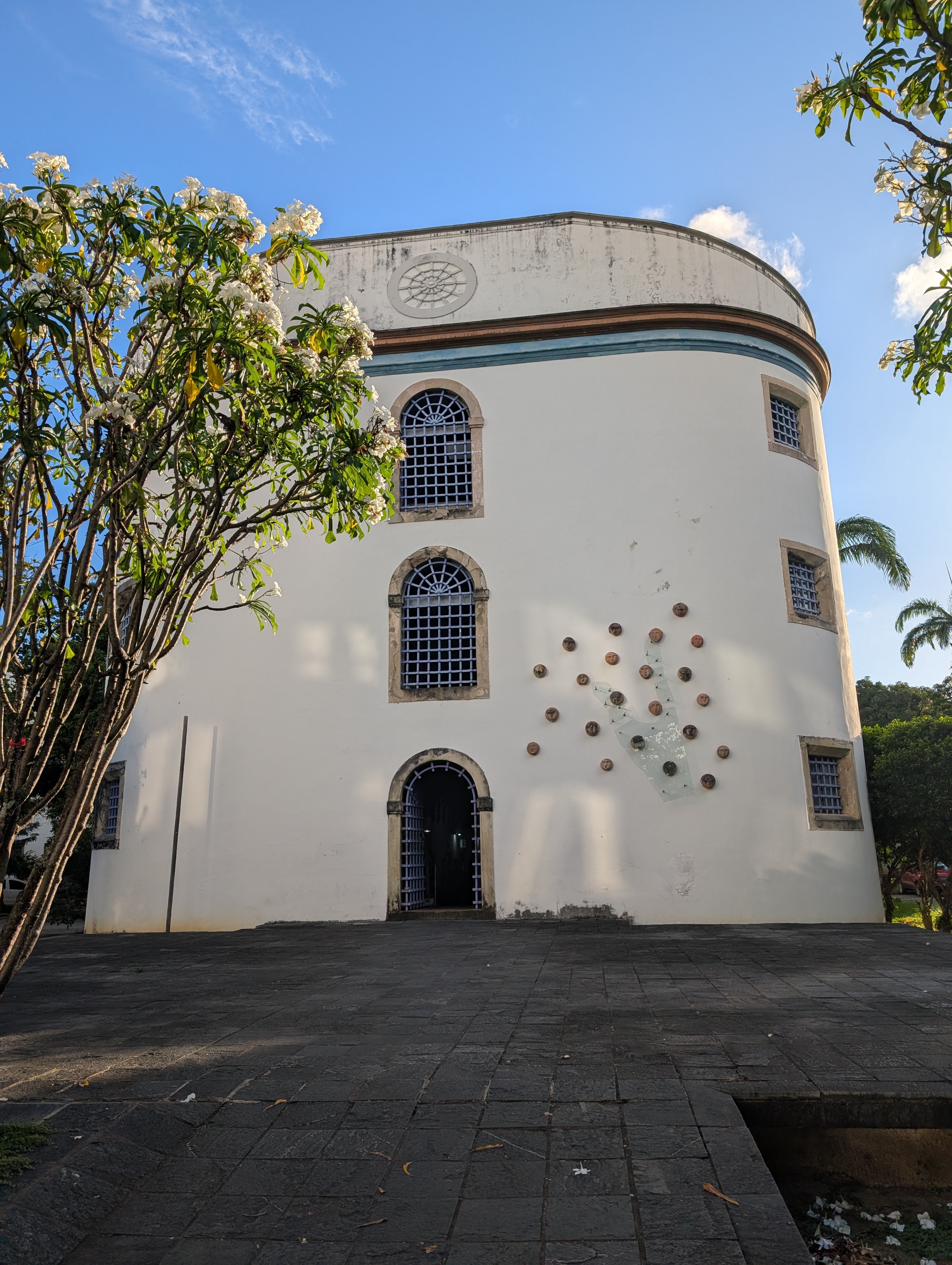
Just like the weekend, during my last week in Recife, I continued to visit places I hadn’t been in a while. We first went to Casa da Cultura de Pernambuco.

The Casa da Cultura de Pernambuco is a historic site and also a cultural hub. It was originally built between 1850 and 1867 and used to be the Recife House of Detention. It operated as a prison for over 100 years until it was closed in 1973.
It was designed by the engineer Jose Mamede Alves as the first panoptic radial prison in South America. It’s shaped like a cross with a dome in the middle, allowing guards to monitor all inmates from one single point.

During Getúlio Vargas’s Estado Novo regime, the prison was used to incarcerate suspected leftists, communists, and labour organizers.
The modernist author of Vidas Secas (Barren Lives), Graciliano Ramos, was arrested in March 1936 while working as the Director of Public Instruction in Alagoas. Accused of sympathizing with the 1935 Communist Uprising (Intentona Comunista), he was held without formal trial or charge. His experience there and in subsequent camps inspired his monumental posthumous memoir, Memórias do Cárcere (Memories from Prison).
Military Dictatorship (1964–1985)
Following the 1964 military coup, the facility again became a frontline tool for political repression prior to its closure in 1973.
Students, union movement leaders, and anti-dictatorship activists across Northeastern Brazil were held in the prison’s wings before being transferred or tried.
The renowned educator Paulo Freire, pioneer of critical pedagogy, was arrested in Recife shortly after the 1964 coup for his adult literacy programs, which the military viewed as subversive. He spent several weeks detained in Recife before going into exile.
Preserved Traces & Cell 106
While most cells were converted into artisan shops in 1976, Cell #106 in the East Wing was intentionally preserved to document the prison’s harsh conditions. Visitors can still see original metal bars, oppressive narrow proportions, and political graffiti or etchings carved directly into the stone walls by former inmates.


The other place we went, and it had been over 30 years since the last time I went there, was the Oficina Francisco Brennand.

The Oficina Francisco Brennand is a surreal open-air museum and sculpture studio set deep within the Atlantic Forest (Mata Atlântica) on the outskirts of Recife.
In 1971, Francisco Brennand (Brazilian artist and master ceramicist, 1927–2019) reclaimed the ruins of the Engenho São João ceramic brick factory, a facility originally founded by his father in 1917, and started using it for his own work. He felt like the kilns could be used to do more than just bricks.
Brennand spent nearly five decades transforming the decayed industrial site into a monumental architectural studio, sanctuary, and museum.

Artistic Style & Atmosphere


Here’s where it gets interesting. Brennand’s signature work merges ceramics, concrete, and bronze, featuring themes of origin, life cycles, flora, fauna, and ancient mythologies. The complex is filled with hundreds of mysterious, totem-like, and erotic sculptures.

Many of his statues depict stylized, exaggerated organs, interlocking human figures, and hybrid beings in states of emergence or transformation. He viewed the sexual act as the ultimate creative catalyst—a metaphor for the artist moulding raw, malleable clay into permanent form.

The sprawling complex features lush water gardens and reflecting pools designed in collaboration with Brazil’s renowned landscape architect Roberto Burle Marx.

Location: Neighborhood of Várzea, Recife.
Hours: Open Tuesday through Sunday, 9:00 AM – 5:00 PM (ticket counter closes at 4:00 PM).

Leave a Reply